Optimizing Recombinant Protein Production for FDA-Cleared Animal-Free Dairy
The production of animal-free dairy proteins through precision fermentation represents a transformative approach to meeting global demand for sustainable, ethical, and scalable milk protein alternatives. At its core, this technology involves engineering a microbial host—commonly Saccharomyces cerevisiae, Pichia pastoris, or Escherichia coli—to express genes encoding dairy proteins such as β-lactoglobulin (whey) or κ-casein. The resulting recombinant proteins are chemically identical to their bovine counterparts, enabling their use in dairy products without requiring animal husbandry. Achieving FDA clearance for such products, typically via the Generally Recognized as Safe (GRAS) notification process or a food additive petition, demands rigorous optimization of the production system from gene design through final formulation. This guide outlines a stepwise framework for process development, focusing on host selection, fermentation optimization, food-grade purification, and regulatory strategy, while highlighting key challenges and practical solutions encountered during scale-up.
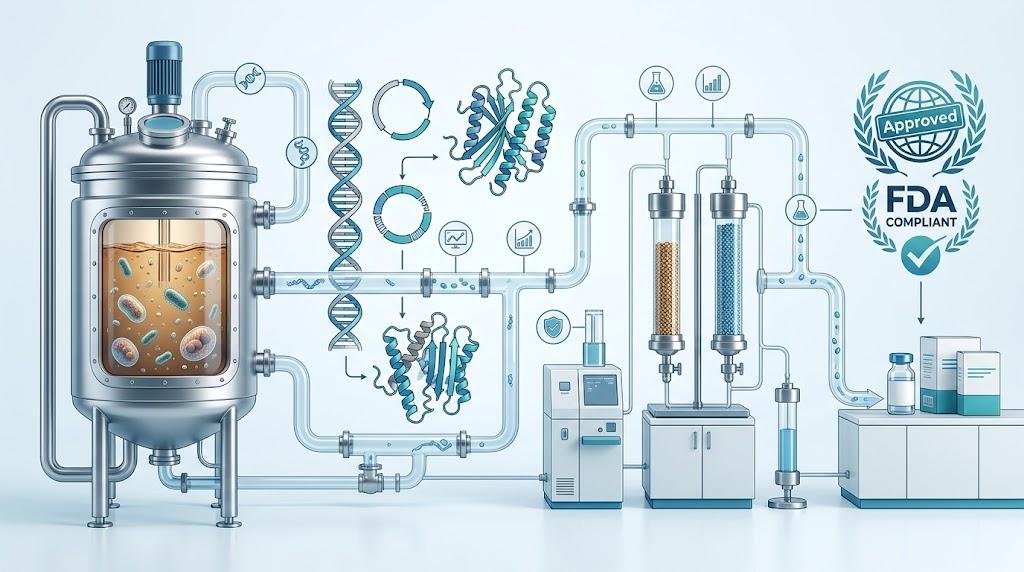
Critical Process Signals for Optimized Fermentation
High-yield recombinant protein production in microbial systems depends on precise control of multiple critical process parameters (CPPs). For animal-free dairy applications, where the target protein must be free of animal-derived contaminants and produced at commercially viable titers, monitoring and adjusting variables such as temperature, pH, dissolved oxygen, induction timing, and feeding strategy becomes essential. In bacterial hosts like E. coli, the optical density at 600 nm (OD600) serves as a proxy for biomass accumulation and, indirectly, for inclusion body formation when the protein is expressed in an insoluble form. Real-time tracking of OD600 alongside CPPs enables process scientists to correlate growth phases with induction windows, reducing batch-to-batch variability. Advanced machine learning approaches, such as recurrent neural networks trained on historical fermentation data, have demonstrated the ability to predict OD600 trajectories and final yields, offering a data-driven pathway to process optimization. For yeast-based systems, additional signals such as methanol concentration (for P. pastoris) and cell viability must be integrated into the control strategy. The goal is to establish a robust process that consistently delivers high productivity while maintaining product quality attributes required for food safety approval.
Induction conditions are particularly critical for animal-free dairy proteins, which often require proper folding and disulfide bond formation to achieve functional activity. In E. coli, isopropyl β-D-1-thiogalactopyranoside (IPTG) concentration, induction temperature, and duration directly influence the balance between soluble and insoluble protein. Lowering the induction temperature to 16–25°C can slow the translation rate, allowing more time for correct folding and reducing inclusion body aggregation. For yeast hosts, methanol-inducible promoters (e.g., AOX1) demand careful feeding schedules to avoid methanol toxicity while maintaining sufficient induction strength. The composition of the growth medium also plays a pivotal role: chemically defined media free of animal-derived components are mandatory for animal-free protein expression. Optimization of carbon-to-nitrogen ratios, trace metal concentrations, and feeding regimens (e.g., exponential feeding in fed-batch mode) can dramatically increase volumetric productivity. Process analytical technology (PAT) tools, including on-line sensors for glucose, lactate, and optical density, provide the granularity needed to implement feedback control loops that maintain CPPs within predefined ranges, thereby enhancing process reproducibility and facilitating regulatory documentation.
The integration of quality-by-design (QbD) principles in fermentation development ensures that critical quality attributes—such as protein identity, purity, and host-cell protein levels—are built into the process rather than tested solely at the end. Risk assessment tools, such as failure mode and effects analysis (FMEA), help prioritize CPPs that most affect yield and quality. For instance, dissolved oxygen levels must be maintained above performance scoped per project saturation to prevent metabolic by-product accumulation, while pH control within ±0.2 units stabilizes enzyme activity and cell physiology. Through systematic Design of Experiments (DoE) studies, the design space for each CPP can be mapped, establishing acceptable ranges that support robust operation. This data-rich approach not only accelerates process transfer from lab to pilot scale but also generates the evidence base needed to satisfy FDA requirements for a well-characterized manufacturing process. In our experience, early investment in comprehensive CPP monitoring and modeling pays dividends during scale-up and regulatory review.
Key Dairy Proteins and Their Expression Challenges
Beta-Lactoglobulin (Whey Protein)
β-Lactoglobulin (BLG) is the most abundant whey protein in bovine milk and a primary target for animal-free dairy production. Its compact β-barrel structure, stabilized by two disulfide bonds and one free cysteine, makes it challenging to express in soluble form in microbial systems. In E. coli, BLG often accumulates as inclusion bodies, necessitating costly refolding steps that reduce overall yield. To overcome this, researchers have employed signal peptides to direct secretion into the periplasm (in E. coli) or into the culture medium (in S. cerevisiae and P. pastoris). Codon optimization for the host organism, fusions with solubility-enhancing tags (e.g., MBP, GST), and co-expression of chaperones have been reported to improve soluble BLG titers at shake-flask scale. However, moving to industrial fed-batch fermentation requires careful tuning of induction parameters—BLG expression under a strong T7 promoter in E. coli can exceed performance scoped per project of total cellular protein but remains largely insoluble. In yeast, methanol-induced expression in P. pastoris has yielded several grams per liter of secreted BLG, though glycosylation heterogeneity must be characterized to ensure the product matches the non-glycosylated native protein. Process development for BLG thus focuses on balancing expression level with proper folding, exploiting secretion strategies to simplify downstream processing.
From a regulatory perspective, BLG is classified as a major milk allergen, and the recombinant version must be demonstrated to be compositionally and functionally equivalent to the animal-derived counterpart. Analytical methods such as circular dichroism, intrinsic fluorescence, and ELISA are employed to confirm secondary/tertiary structure and binding properties. The absence of bovine immunoglobulins and other milk proteins in the final product must be validated, as even trace amounts could trigger allergic reactions. Furthermore, the fermentation process must use animal-free bioprocessing components, meaning that all media additives, antifoams, and purification reagents must be sourced from non-animal origins. This requirement influences the choice of host strain: P. pastoris is favored for its ability to grow on minimal defined media and secrete high levels of properly folded BLG without animal-derived supplements. Once a consistent process is established, the manufacturer can compile the necessary safety data for a GRAS determination, including allergenicity assessment, compositional analysis, and a history of safe use for any novel processing aids.
Kappa-Casein (Casein Micelle Component)
κ-Casein is a critical component of the casein micelle, essential for the emulsification and curd formation properties of milk. Producing recombinant κ-casein in microbial hosts presents distinct challenges due to its high degree of O-glycosylation and its tendency to form amphiphilic aggregates. While E. coli cannot perform O-glycosylation, P. pastoris and other yeasts can incorporate O-linked glycans, though the pattern differs from the native bovine profile. For many food applications, the glycosylation may not be required for function, but the regulatory authority will require evidence that the expressed protein is safe and performs as intended. Expression of κ-casein in P. pastoris has been reported using the AOX1 promoter, with secretion guided by a yeast signal peptide. Yields are typically lower than for BLG, and purification must remove proteolytically cleaved fragments that arise from the host’s endogenous proteases. Employing protease-deficient yeast strains and optimizing the growth pH to minimize protease activity (e.g., pH 3.0–5.0) can improve product integrity. Additionally, fed-batch fermentation with controlled methanol feeding and oxygen saturation helps maintain productivity while reducing cells stress.
Purification of recombinant κ-casein often involves a combination of cation-exchange chromatography and hydrophobic interaction chromatography, exploiting the protein’s isoelectric point and amphipathic nature. Because the final product must be food-grade, all chromatographic resins must be sanitized with FDA-acceptable cleaning agents, and elution buffers must be free of toxic solvents. The downstream process should be designed to remove host-cell proteins, DNA, endotoxins, and any residual culture medium components to meet purity specifications typical for food ingredients (> performance scoped per project pure). Analytical characterization includes SDS-PAGE, N-terminal sequencing, and mass spectrometry to confirm primary structure, as well as functional assays such as calcium sensitivity or rennet coagulation tests to demonstrate micelle-forming capability. For GRAS notification, the manufacturer must provide data on the intended use level in food, dietary exposure, and lack of adverse effects. The process development strategy for κ-casein therefore integrates strain engineering, fermentation optimization, and food-safe purification under a unified quality framework that aligns with FDA expectations.
Core Fermentation Optimization and Scale-Up
The journey from a laboratory-scale shake flask to a commercial stirred-tank bioreactor is the most demanding phase in animal-free dairy protein production. At the heart of this scale-up is the need to maintain consistent cell physiology and product yield across orders of magnitude in volume. A typical development path begins with assessing host strains and expression constructs in controlled shake flasks, where parameters such as inoculation density, medium composition, and induction conditions are screened using DoE. Promising lead strains are then transferred to bench-scale bioreactors (1–10 L) where key CPPs—temperature, pH, dissolved oxygen, agitation speed, and feed rate—can be precisely regulated. Here, the interaction between CPPs becomes apparent: for example, in P. pastoris methanol-induction, the specific growth rate during the glycerol batch phase directly influences the cells’ ability to metabolize methanol and produce the target protein. Therefore, a three-stage fed-batch process (glycerol batch → glycerol fed-batch → methanol induction) is commonly optimized, with each stage’s duration and feed rate defined by strain-specific kinetics. Use of recombinant animal-free proteins production requires that all fermentation raw materials, including glycerol, methanol, and trace elements, be verified as animal-free, and that the process does not introduce any carryover of animal-derived components.
Scale-up to pilot (100–1,000 L) and production scales (≥10,000 L) introduces challenges related to mixing, oxygen transfer, and heat removal. At larger scales, gradients in substrate concentration and dissolved oxygen can develop, leading to zones of oxygen limitation or excess methanol that trigger metabolic stress and reduce yield. To mitigate this, computational fluid dynamics (CFD) modeling is increasingly used to predict mixing times and identify impeller configurations that maintain homogeneity. Additionally, the feeding strategy must be adapted to compensate for slower mass transfer; ramped or exponentially increasing feed rates can maintain the desired specific growth rate throughout the induction phase. In our practice, pilot-scale runs are designed to mimic the full-scale process as closely as possible, with at least three consecutive batches demonstrating reproducibility in key performance indicators such as maximum OD600, volumetric productivity (g/L), and product quality. Any drift in these parameters signals a need for process adjustment, often related to raw material lot variability or equipment differences. The final scale-up campaign should produce sufficient protein for formulation, stability testing, and the toxicological studies required for FDA submission.
Beyond the bioreactor, medium optimization remains a continuous effort. Chemically defined media are preferred for animal-free dairy because they eliminate batch-to-batch variation from complex nitrogen sources like yeast extract or peptone (which can also be animal-derived). However, defined media often require supplementation with specific amino acids, vitamins, and cofactors to support high cell densities. For P. pastoris, the transition from complex to defined media frequently reduces productivity by performance scoped per project initially, requiring iterative optimization of trace metal and vitamin concentrations—particularly biotin and thiamine—to restore yields. Real-time metabolomics analysis using rapid sampling systems can identify metabolic bottlenecks, such as overflow metabolism leading to acetate (in E. coli) or ethanol (in yeast) accumulation, which inhibit growth and expression. Once the medium and feeding regimen are locked, the process is formally defined as a master batch record, capturing all CPP ranges and in-process controls. This document becomes the foundation for technology transfer to the manufacturing site and is critical for the regulatory filing. By systematically addressing these scale-up challenges, developers can achieve the robust, reproducible fermentation process required for commercial animal-free dairy production.
Downstream Processing and Regulatory Strategy
Downstream processing of animal-free dairy proteins must satisfy both product quality and regulatory requirements while maintaining economic feasibility. The primary goal is to isolate the target protein from the fermentation broth or cell lysate using food-grade unit operations that avoid the use of animal-derived reagents or toxic chemicals. For secreted proteins in P. pastoris, the harvest typically involves centrifugation or microfiltration to clarify the broth, followed by ultrafiltration for concentration and diafiltration to exchange the buffer. If the protein is expressed intracellularly (often the case in E. coli), cell lysis by high-pressure homogenization is performed, and the insoluble fraction containing inclusion bodies is collected, washed, and solubilized under denaturing conditions. Refolding is achieved via rapid dilution or dialysis, and the renatured protein is purified through a sequence of chromatographic steps: affinity capture (e.g., using a His-tag), ion exchange, and size-exclusion chromatography. For food-grade applications, the affinity tag must be cleaved if present, or alternative tag-free purification methods such as hydrophobic interaction or hydroxyapatite chromatography are employed. Throughout purification, the absence of animal-derived components is verified; for instance, UNOsphere Q and SP resins, or ceramic hydroxyapatite, are acceptable food-grade resins when sanitized per manufacturer guidelines.
Quality control (QC) for animal-free dairy proteins encompasses identity, purity, potency, and safety. Identity is confirmed by N-terminal sequencing, peptide mapping via LC-MS/MS, and intact mass analysis. Purity is assessed by SDS-PAGE (reducing and non-reducing), analytical SEC-HPLC for aggregates, and RP-HPLC for variants. Host-cell protein (HCP) levels are quantified using a platform ELISA or LC-MS method; typical acceptance criteria are ≤10 ppm HCP for food ingredients. DNA content is measured by qPCR and should be ≤10 ng/mg protein. Endotoxin levels are determined by LAL assay (using a recombinant factor C version to avoid animal-derived reagents) and must meet the <10 EU/mg limit for food applications. Additionally, each incoming fermentation batch undergoes bioburden and mycoplasma testing to ensure the absence of microbial contaminants. A comprehensive stability program (real-time and accelerated) under representative storage conditions defines the shelf-life and establishes holding times for intermediate process steps. All QC results are compiled into a certificate of analysis that accompanies each product lot, providing the traceability required for regulatory submissions.
The regulatory pathway for FDA clearance of animal-free dairy proteins typically follows the GRAS notification process. The manufacturer must demonstrate that the recombinant protein is safe under its intended conditions of use; this requires a detailed description of the production process, characterization data, and a history of safe use or toxicological studies (e.g., 90-day feeding studies in rodents). The assessment also includes evaluation of potential allergenicity using bioinformatics tools to compare the protein sequence to known allergens, and if significant similarity exists, additional in vitro or in vivo allergenicity testing may be necessary. For proteins derived from genetically engineered microbial hosts, the FDA also reviews the safety of the production strain, including the absence of antibiotic resistance markers (or their removal) and the stability of the genetic construct. The final GRAS submission should include a summary of the fermentation and purification processes, compositional and purity data, environmental fate of the production strain, and an exposure assessment based on the intended use level in food products. Engaging with the FDA through a pre-submission meeting can clarify data requirements and reduce the risk of a “no questions” letter that fails to accept the notification. With a well-designed process development strategy that integrates upstream and downstream optimization, robust QC, and thorough safety testing, manufacturers can achieve FDA clearance for animal-free protein development and bring sustainable dairy alternatives to market.
References
- Hoffman SM, Lalwani MA, Avalos JL. Light-Controlled Fermentations for Microbial Chemical and Protein Production. Journal of visualized experiments: JoVE. 2022 Mar 22.

